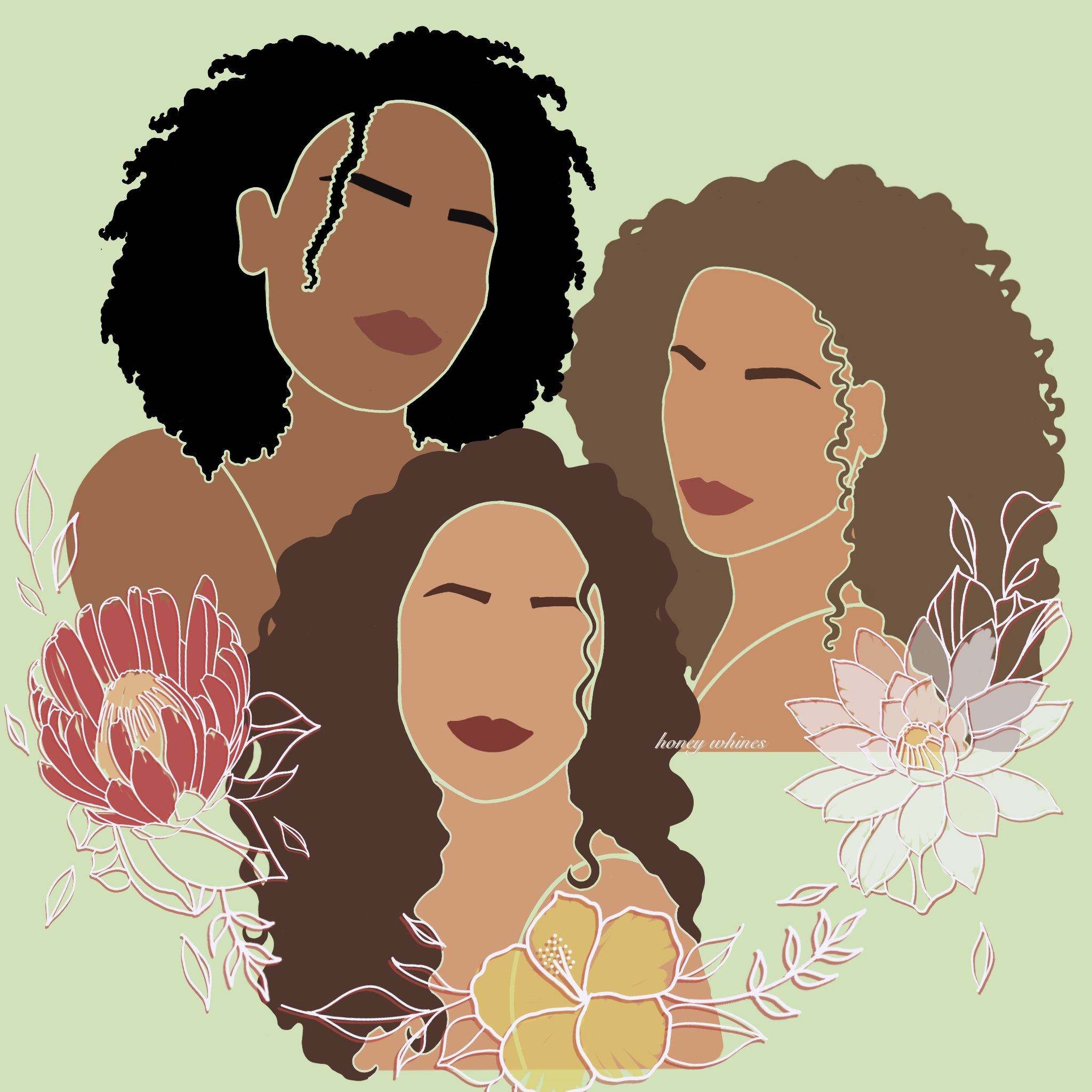

Just Black (And Beautiful)
By Kamryn Brinson
Kamryn: Black American/ African American
Ana: Hawaiian, Panamanian
Alexandria: Guyanese, Caucasian (Czech and German etc.)
Looking at the three of us, there’s varying skin tones and hair textures. I am the least ambiguous looking, though speculations as to my race are posed to me every now and again. I am definitely a light skinned (high yellow in the winter) black girl, 4b curls, button nose with a slightly wider bridge, mid-sized lips. Allie looks like a black and white mixed girl, light brown skin, 3b/3c curls, European nose, full lips. Ana looks like something else entirely- 2c/3a natural auburn hair, light skin filled with freckles, full lips.
Each of us has our own look about us, and let me tell you: Ana and Allie are genuinely two of the most gorgeous girls I’ve seen, even if I didn’t know who they are on the inside. They’ve had and still do have struggles as to their place in the world. Too white for certain spaces, too black for others, and too other to fit in any clear box. Their place in the world is just as ambiguous as their looks, which is, unfortunately, a given in a world where race, ethnicity, and physical presentation determines your status, your community, and your ability to move throughout society.
My mother, born of two black parents (both light skinned but definitely black), was born the same complexion as Ana, sans freckles. She was bullied by her cousins- called “rainbow” and speculated to have been adopted. She fought hard to be seen as who she was, a black child from a black family with a black sister that happened to look way less ambiguous. Her light skin and her very loose curls set her apart but she embraced them. She knew there was no other way she could look, so why not. Despite her appearance, she was raised as and moved through the world as a black woman. She then raised me and my brother to believe the same. That anyone that has black blood is black, no matter their appearance. The good ole One Drop Rule.
The One Drop Rule was a legal principle to classify race used as early as the Middle Passage up through the Civil Rights Movement. It states that any person with any African or black ancestry was considered black as well. Though there were more distinctions as to colored, mulatto, mestizo, or negro that clouded that sphere, the One Drop Rule was a clear way to separate whites and non-whites. From a black perspective, it gave us more people on ‘our side.’ I grew up with this mindset and embraced it; even going as far as to adamantly tell Allie and Ana they were black, even when they questioned that label not embracing all sides of their identity. I recently apologized to them both for that. I was so caught up in the idea that if they had even a little black, they were black end of story. That wasn’t fair to them at all, and now I personally do not call them black. Allie and I recently got into a disagreement about it, actually, but that term does not apply to them (in my opinion) because they are mixed racially, ethnically, and culturally.
The use of the One Drop Rule to include mixed and ethnically ambiguous women is, unfortunately, to the detriment to black women. Outside of the basic disrespect of not allowing mixed women to be true to all aspects of their ethnic and cultural makeup, it harms black women’s representation in society as well. Let’s take a look at the most popular young “black” actresses in 2023. The top five of the list is Zoe Kravitz, Zendaya, Zazie Beetz, Teyonah Parris, and Nathalie Emmanuel. Only one of these women is unambiguously black, Teyonah Parris. In fact, the other four women are confirmed to be of mixed race; these women are simply not black women. They are also noticeably closer to the European beauty standards upheld in western society– lighter skin, thinner noses, medium to full lips, looser curls. They are mixed women, and they are valid, talented, and beautiful in their own right. But why are these mixed women on the list of “40 Hottest Black Actresses under 40”? Granted, “hottest” may not be the most appropriate classifier to determine their popularity in the industry, but my point remains the same. Mixed women are often used to fill roles meant for black women because the general public (majority white) will accept them on the screen as a ‘black’ woman without having to face the starkly different appearance of an unambiguously black woman.
In a time where dark skinned black women are still compared to animals, called manly and aggressive, and are shamed and devalued because of their skin, it does not help that women who look so very different from them and genuinely are so very different from them are called representation. They cannot look to the screen and see someone like them, even if the public says “yay, more black female representation.”
I do not make this point to further sew dissension among people of color. People of all shades and lifestyles face experiences of oppression, discrimination, and sometimes even aggression from the dominant powers in society. My point is that the experience of mixed women, which I cannot speak from personal experience on, is different from the experience of black women. ((As a light skinned black women, I cannot even speak personally to the experiences of that of a dark skinned black woman– though I have taken time to educate myself and others on the colourism and misogynoir pervasive in society.)) Mixed and black are not the same thing, and I do not think they should be classified as such. One is not better or worse, and neither group should discredit or hurt the other. We are all beautiful people of color, whatever shade.
The Black and The Not Black Enough
By Alexandria Bullen
Let me preface by saying, I am a huge supporter of seeing more black women of darker complexions in the media and on TV. I stand with you, Kam, to say you are beautiful and worthy and divine in your own way and European beauty standards suck as we all know. However, this doesn’t mean women of color with lighter complexions should be torn down as a result. Furthermore, as I am trying to understand your perspective, as a mixed black woman, I believe that you are still living in this world unable to refrain from categorizing diverse skin into a “not black” or “black” category which is still a huge problem for me personally. I can only speak for myself in this matter because my experiences and feelings related to the struggles of this topic cannot be generalized to the experiences of all mixed people. However, this is a problem that I continue to face every day not only from strangers, but from people who I am close to, so I want to share my perspective on this topic.
With my personal experience living as a mixed woman and the harshness I have received from both men and women from the black and white communities; I believe there is a fundamental flaw in the way mixed people are categorized. I do admit I am sensitive to this topic because it is something I have struggled with my whole life. The “one drop” rule, although not a legitimate law today, taught to categorize every person with at least one drop of color as simply “black”. This was a very real rule that we still see the implications of to this day when a mixed person is forced to check the “black” box on paperwork, or when we are considered “black” to the eye of the police officer that pulls us over, even though we are mixed with other ethnicities. On the other hand, it’s just as harmful to shift to the opposite end of the spectrum and categorize mixed people as being “not black” simply because we have complex undertones, different hair textures or ambiguous facial features compared to the “standard” full black woman. This standard is unreasonable and also unattainable because no single person looks the same. And no single black person looks the same. I have seen “full black” women with slimmer noses and thinner lips. Or the opposite, lighter skinned with fuller lips and a wider brimmed nose. Or a mixture of both! My point is, there are a million combinations, so to be so selective on who falls in this “full black” label based on appearances or features alone is a flawed argument from the start.
To say, ” ‘black’ doesn’t apply to them”, means in other words, black doesn’t apply if you have other hints of ethnicities in your appearance or complexion which is incorrect. This stance is as impractical as Kant’s view on morality– an act is either right or wrong and there is no in between. In both scenarios, this absolute and unconditional way of thinking lacks sense and application to persons with complex identities and the challenges of the real world, respectively. Instead of trying to fit people into categories, we should just accept that people can have different sides to them and embrace that people identify with every element of what makes them, them.
Now that we have covered the impracticality of the “black” versus “not black” categories, you may be wondering if it’s safe to label us as “mixed”. In my opinion this term is warmer, and I personally identify with “mixed”, but this category can also have negative connotations if used improperly. It is never good to generalize and the word “mixed” is an all-encompassing, catch-all term that resembles the word “other” which we see so often in a negative way. The term “other” screams– too complicated to figure out what exactly you are so just check “other”. This term does a great job at making us feel different and even more alienated than we already feel in society. The main point I’m trying to make is at the end of the day all we wish is to be fully seen. Fully recognized for everything the label “mixed” or “other” encompasses. Not every black person is the same. There are a total of 54 countries in Africa, all with independent cultures and pigments. Additionally, black people of African descent are only one of the many types of black cultures that exist. What about the black people whose ancestry is far removed from Africa? My father is from Guyana, a South American country bordering the Caribbean. My family is far removed from the African origin, and we attribute our culture more closely to the West Indies than to Africa. So, my point is, there is no single black identity and there are even more identities and combinations associated with the term “mixed” and I’d like to be recognized and accepted for every part of me, including the part that I classify as black.
Instead of putting a label on me, I would hope to be accepted and valued for all pieces of my identity. There is no problem being this AND that and I think as a society we still struggle to grasp this by the words of absolute we continue to use to explain this concept. Trying to fit people into a category will do more damage as it ultimately erases one side or the other of their identity. Or worse, makes someone question their own identity and what is acceptable for them to identify as. In other words, by using the language “not black” you erase that side of me. And by placing me under an umbrella term such as “mixed” you can make the mistake of lumping all “ambiguous” people together, blurring their individual cultures that make them unique. But if you insist on calling me anything, “mixed” or “biracial” at least captures all sides of me if you don’t know the specifics of my ethnicity. I understand this is difficult to grasp because it feels like it’s not safe to call us anything. My intent isn’t to confuse you, but if your intentions are to respect someone’s ethnicity and race, try and refrain from immediately placing them in a category and instead recognize that there is more depth to their identity than what is seen in their appearance. We need to be more fluid with our definition of what it means to be black. Like the fluidity of gender, identity, and sexuality.
I understand it may not be your intention to cause further diversion between the full black woman and the partial black woman, but again, your language is portraying a different message. To say a mixed woman of “lighter skin, thinner noses, medium to full lips, looser curls– These women are simply not black women”, can be taken as an insult because, again, you are erasing the black side of them. A mixed woman or a lighter skinned black woman should have the same right to consider themselves a “black woman” when that is very much a part of their identity. Just because they do not perfectly adhere to the darker complexion or features of this so-called “true” black woman, doesn’t mean they are not black women.
This nonstop comparison of a true black woman versus a mixed black woman or a light skinned black woman contradicts the positive things you say about respecting and accepting all shades of color. I understand the unfortunate fact that the lighter complexion paired with European features is favored over a darker complexion, but coming from a woman who has felt ashamed for her more Caucasian features, why cast that same shame and guilt on these mixed black women artists and actresses for the way they look. This negativity can harm a mixed person’s self-esteem and will contribute to our further alienation in society. By questioning how and why these women have success, you downplay their struggles, and you invalidate their successes as a light skinned black or mixed woman by correlating their fame with being “light skinned” or possessing European features. Regardless of what shade of black you are, no one wants to be made to feel like they are a token black person that didn’t authentically earn their accomplishments.
Everyone has their own struggles, no matter how dark or light their complexion is. I can also say the same for privilege. These struggles and privileges are unique to everyone. The one drop rule is true in the fact that a mixed person will also never have the privilege of having pure white skin. On the other hand, light skinned may have more privileges than a darker complexion, but there are also many different factors that can give someone more privilege and complexion is only one of them. Regardless of the type of privilege, it still isn’t right to tear mixed people down or downplay their struggles and accomplishments based on complexion or western “beauty” standards. To shame anyone for their skin tone, the reason for their successes, or to invalidate their individual struggles in any way is unnecessary.
All in all, I am Afro-Guyanese, I am white, and I am mixed, and these are all parts of my identity, and I will accept all sides of me equally without being made to feel ashamed or resentful for what I am and what I may lack. Everyone is allowed to feel like they deserve to take up space in this world no matter their complexion, hair, features, culture, or background. So, continuing to make space for a discussion based on the differences between the “true black” and the “not black enough” only exacerbates the already existing dissension between women of color. Treat everyone as a unique and individual person in this world with their own unique contributions and challenges. I want to create a conversation that defines the term “black”, in today’s society, as a spectrum of different brown shades and cultures. To those reading this, I may not be black enough, I may not be white enough… but I am enough.
Discussion
I’m not categorizing individuals as black and not black. I think that purposely limits my argument. I’m saying black (monoethnically black) is its own thing. It’s not a subjective as morality- there is no good or bad or between. Race and phenotype are determined by genetics. Ethnicity and culture are where things can differ in terms of how you’re raised. Being partially black and partially something else means that you are not just that one thing. Whereas others are. Which means you are not the same as the person that is just one thing. I agree partially with the idea of ‘everyone has multiple identities so we should do away with categories all together’ but in saying that, it invalidates the people who do only have one identity- that has been repeated shat on– and it goes directly against the idea that you or Ana would want to even be called/identify as black. If there’s no labels, you wouldn’t have it either.
Additionally, sexuality and race are two very different things. To be ‘racially fluid’ to some people would be considered appropriation to other people. If anyone can adopt whatever race they want, without having any actual connection to it, it can psychologically impact the individuals of said race who do not have the ability to do the same. -Kamryn
I didn’t bring up the fluidity of gender and sexuality in the sense that I believe that anyone of any race can identify with being black. I brought it up as a comparison because this fluidity we are able to recognize and can comprehend in today’s society. To emphasize the point I was originally making, in terms of individuals that are ambiguous that have a connection to black heritage, we should be more fluid with categorizing them as black and not black…hence my point on being more fluid with the definition of what it means to be black. -Alexandria
I understand not wanting to be placed in any type of categorization, but that is important for many aspects of the world– like census data. The census is usually used to determine the status of communities– the need for public aid, the housing state, the family success rates, the school system statistics. – Kamryn
This reminds me of redlining. The practice of categorizing communities based on their ethnic or minority makeup which caused very negative consequences. Why would this be a point to bring up as if this was not hugely detrimental to the minority communities and continues to be. Why would we want to keep this harmful classification and categorizations if they are ultimately used in harmful and unfair ways towards people of color. Although you argue it will help in other ways, historically speaking why fight for this categorization when for the majority of our history and now it’s been only harmful to us. – Alexandria
Because we live in a society with a broad mix of individuals, there isn’t really space logically, for everyone to not fit into any category. Just like animal classification, the whole Kingdom, Phylum, Class, Order, Family, Genus, and Species; obviously all humans have the same breakdown, but there are things that separate us as well. The same goes for animals: we have mammals, birds, fish, amphibians and reptiles. There has to be basic characteristics to simplify the system. Every animal has its name and traits, but they do not NOT fall into a category just because they don’t want to. – Kamryn
This point you bring up about animal classification… it feels like colorism or shadeism with the way you are describing it. In other words, using this comparison feels like you are separating people that share the same ethnicity based on darker and lighter complexions. Essentially, dividing people of color even further. Even though shadeism was a very real and unfortunate part of our history (we saw this with lighter servant slaves vs darker field slaves), this comparison feels like we are essentially keeping shadeism alive when in today’s society, people of all brown shades are standing and fighting together as one.
Animal classification shouldn’t be compared to the human race. We are all humans. Race is essentially a made-up construct that we, humans, have created to classify and categorize individuals and ultimately DIVIDE us. With there being such a broad mix of individuals it only makes sense that we refrain from categorizing. People these days are becoming so vastly different with various complexions, hair, features, cultures, mixes of so many different things that often we find that MORE people than not are falling into MULTIPLE categories and spaces. So logically it makes sense to forget the categories. It only makes it that much harder for individuals with mixed cultures and ethnicities to fit into these said categories. With NO categories, people of mixed backgrounds are able to feel a greater sense of belonging within the community without the discomfort of choosing between the different parts that make them, them. And to ultimately live in this world feeling comfortable and invited in all spaces that they identify (share heritage) with. – Alexandria
Categorization exists in every part of life, from the jobs we work, to the foods we eat. Race is the same, and I don’t think that is an inherently bad thing. Discrimination and mistreatment based on race IS, but the distinction itself is not. In fact, it allows that individual to be defined exactly as they are and exactly as they were culturally raised to be. – Kamryn
The discrimination became prominent because we were so hyper focused on this distinction and classification of races. I feel like this is a very fine line to ride. At the end of the day, my point is that we shouldn’t see people for only their color or appearances. In such a progressive society, this should not be the first thing that we focus on. In my opinion, this whole argument feels like we are reverting back and it feels unnecessary. We should focus on taking people for who they are as human beings not just from face or skin value. – Alexandria
Identifying as a mixed and biracial woman, which you identify as and are, is different from identifying as a black woman. That is my entire point, full stop. I agree that we shouldn’t see people as just a color or by their appearances- that’s not really the discussion we’re having. If we were living in a society where that didn’t already exist, then this entire topic wouldn’t matter. I think it is harmful to not acknowledge the privilege mixed or ambiguous people have in moving through an increasingly mixed and ambiguous presenting society. Yes, there are many hardships that come from being mixed and feeling pulled between two or multiple parts of yourself, but that is literally what makes a person mixed. The race of the parent raising a mixed child also plays a big role in how the child interacts with its different racial communities (look at the interesting tiktok discussions by mixed people about mixed people raised by a black mom and mixed people raised by a white mom), but that is beside the point. Being mixed is different than not being mixed. Not better, not worse, but different. There are societal privileges (based in white supremacy, racism, colorism, texturism, misogynoir) that people who appear mixed or ambiguous receive based on their appearance. Is it fair, no. Is it mixed or ambiguous appearing individuals’ faults, no. Is it real, yes. I see it similarly to white or male privilege. It is not an individual’s fault for being born as they are. There is nothing inherently wrong and right about their existence; they just are. It is not a reason to push them away and discriminate. But it is their job to recognize their privilege and acknowledge that the way they move through the world is not the same as those who are marginalized by the very same system they are elevated in.
Let’s look at this through a different lens. Replace race with gender (given that both are social constructs originally drawn from biological characteristics). Already acknowledging that society’s view is too narrow and often based in discrimination and bigotry, let’s look at the dynamics in how a trans man and trans women are treated before and after transition. Now, for this comparison to be based on appearance and make sense for the discussion, these individuals must “pass” as the gender they identify as. Many trans men, especially white trans men, have expressed that they were treated with more respect and were deferred to more both in the workplace and socially after their transition. Having experienced life presenting as a woman or girl and being viewed as a woman, they noticed a marked difference when society then viewed them as a man. Is it the trans man’s fault that he benefits from patriarchy and sexism? No. Do the systems in place– however unfair and skewed– still exist, yes. Does he still benefit? Yes.
It is not my purpose to lay blame or create further division, but I think division already exists, and you are purposely ignoring it without acknowledging that you have the privilege of ignoring things others do not. We are all human beings. We are all mixes of our parents and grandparents and ancestors. No one is the same as anyone else (except identical twins I guess). Yes, racial classifications were originally made in order to define certain groups as superior and inferior by characterizing color, texture, language, cultures and then fabricating connections to intelligence or delinquency levels. That was all wrong, and because it was done, does not mean it needs to stay that way or continue to exist. But just as gender discrimination and sexism is still a thing despite the catching acceptance that gender is a spectrum, so is racism. Outdated and discriminatory practices are written into law– physically, religiously, and socially. They do not go away just because we don’t want them to apply to us. It will take time to dismantle them, and I do believe we can get there.
I believe people of color deserve the world (not in a derogatory way to non-POCs, you guys are great too 🙂 ). We as a collective have the power to change things and create and inspire and flip the world on its head. But I do not think that will be done when people are not objective and thoughtful as to their own positions within and outside of communities. Outside of the idea that mixed and/or ambiguous women are often deemed more desirable and palatable by the white public as I discussed in the original piece, people who are closer to the European standard of beauty or look ‘foreign’ or ambiguous are uplifted in the black community.* That is a fact. I simply do not think it makes sense for people who are not fully and only black to be elevated over people who are fully and only black, inside of their own community- the black community. The elevation should not exist at all, frankly, but it does. And to ignore that is harmful to the women cast aside in their own community that has expanded to fit people that are not what they are. Black.
*There is a long and interesting discussion to be had about black men’s historical chase after ‘whiteness’ and proximity to it, rooted in white supremacy. – Kamryn
I identify my privilege’s as a biracial woman. I do. I am not oblivious to the realities of my lighter complexion, I promise you this. I have personally felt this privilege solely on how easy it is for me to be recognized by both black and white communities. I did make known the challenges I face as a biracial woman, but that doesn’t mean that I don’t recognize the benefits that come with my complexion. However, I think the main difference between our arguments is that although I recognize these differences between us, I want to shift the conversation to a more healthy and inclusive perspective. Instead of focusing on a discussion that may harbor negative feelings and division, my goal is to progressively shift the perspective to focus on rejoice our union as colored women. I recognize my own privilege, and I believe that most biracial/multiracial individuals do too and I wish this wasn’t the reality. BUT by a simple shift in the language and tone we use to communicate this reality, can either bring us together or tear us apart further. I recognize the past and what still exists, but I don’t want to live there. I want to move forward together, empowering each other, not exacerbating our separations. – Alexandria
I understand your point and I value it, truly. While rereading our earlier discussion, I reread a phrase that hit me in an uncomfortable way, just as it did the first time I read it. You say that you believe we should expand or “be more fluid on what it means to be black.” Perhaps this is my internalized trauma or bitterness, but it does not make sense to me why black people are being forced to expand their identity or let others fit into it, when other groups are not forced to do the same. No one is telling white people to expand their idea of whiteness or be more fluid in determining what is white. No one is saying that to asian individuals. I may take it too personally (and maybe some might see it as a reach), but as a race who has already been stripped of so much of its identity and culture when we were kidnapped by slavers or sold by our brothers and sisters and brought to a new land where we were determined at every turn to be inferior — because of our skin, because of our shapes, because of our hair, because of our languages and religions– it genuinely feels unfair that we must again give up the identity we’ve fought so so hard to be proud of. “Black girl magic” this, “black girl magic” that. Kinkier textures, darker skin tones, curvier bodies- all of this was devalued for so very long, and black women fought to reclaim it and make others embrace it as magical and beautiful. That means the world to me. And at the same time, those same women are not valued as highly within their own community as they should be. Black and brown people are beautiful and diverse in every shape and shade they come in. There is no doubt about that; I stand on it ten toes down. But I refuse to just accept that the black community can rightfully be forced to shift or change its identity while other communities are not. It feels like another form of oppression, to be completely honest. If we were having frequent conversations about the white community expanding its ranks to fit mixed individuals that are visibly people of color (regardless of skin color or phenotype), I would understand. But we are not.
Again, none of what I am saying is to make it where mixed people have nowhere to go and must be alone and outcast. That would be horrible, and that is not my point. My point is that mixed people have their own distinct identities formed from whatever mixture of their parents. In mixing two (or more) different things, you have created something new. The mixed experience is something only mixed people can truly speak on and relate to, I believe. It would not make sense for anyone else to speak for you, given that they do not have that experience. With the growing number of mixed and multiracial individuals in the United States, there is no reason people cannot connect upon that shared experience. There will always be a flow of mixed people between all of the aspects of their identity, and I believe people should explore and embrace all that makes them who they are. That exploration and movement within communities shows in and of itself that mixed people do not belong only to the black community because they are not only black. People should be proud of who they are, all parts of themselves. That being said, I think black people should be able to be proud and distinct in who they are, given all that has happened, and not be expected to again change themselves or their identity due to the opinions or feelings of a societal norm. Because honestly, if we are looking at it from an outside lens, it makes sense for people of any amount of color to be automatically reclassified as “black” (within America) if they are not distinctly another race ie. Asian, Latinx, Native American, etc etc. That speaks to the idea of “white purity.” The white community is usually very clear about who is white and who is not. That is, largely, because they have given themselves that power. Taking out the resulting negative impacts of the bigotry and discriminatory actions caused by white supremacy, by classifying themselves so distinctly, everything else is other. They preserve the ‘white’ identity, regardless of how it changes from individual to individual through skin tone, hair texture, body shape, language or religion. Using the narrative that anyone who is partially black should automatically be shoehorned into the black community, and that the black community has to just expand its identity to fit them is directly tied to white supremacy. We’ve comically looped back around to the one drop rule.
I will rant and rave about the beauty and the power of the unity between colored women (and other POCs) until I am blue in the face. That unity, however, I do not agree should be to detriment the black woman and her distinct identity. – Kamryn
I Belong Nowhere and Everywhere, What Am I?
By Ana Thomas
I’ve been told I had to choose a side. I’ve been told I’m not black enough and I’ve also been called “the black girl.” I’ve been called “Hawai’i” as an actual nickname. I’ve been asked more times than I can count, “What are you?” with the familiar head tilt and eyes filled with confusion. I can always sense when the question is coming. It’s usually mid-conversation, and usually within the first time of meeting someone. They can’t quite figure it out and it tells me that they’ve been trying to categorize me this whole time, but they haven’t settled on one.
This question used to overwhelm me and there’s times where it still does. I’ve almost broken down in tears trying to answer this question. I felt that I needed to defend every part of who I am, even though they weren’t’ necessarily attacking me. The incessant need for categorization is exhausting for the people who never seem to belong to one. And I think that’s what a lot of this whole conversation boils down to: BELONGING. We all want to belong to a group because as humans we crave this sense of belonging. I think it’s a part of our survival instincts. It’s harder to survive alone. We have to know, ‘Can I trust you? Are you an ally? Are we the same?’
When I’m told that I’m not enough of something, it feels like I lose claim to a part of me. That’s some percentage of me floating away and now my cup is not at 100%. Then I’m told I’m not enough of something else, now my cup is almost 50% nothing and 50% of more things I’m not enough of. We can keep going until I am just nothing. Not enough for the categories the world prioritizes over people themselves. I am understanding of the purpose of categories, they make people comfortable and allow people to navigate life. I’m not making an argument to knock down the purpose of categories, I just want to illuminate the impact they have on people who seem to only fit into one; the ‘other’ category. The use of ‘other’ on the census form is understood (again), but also feels dismissive. No intent to further understand who these ‘other’ are maybe because it’s too difficult, too unnecessary, too unknown. I’m not… too sure.
To Kam, you once told me that I am a Black woman. I wanted to believe you, but I felt that being a Black woman negates every other part of me. Now, you say I’m not a Black woman. Here is where language matters. I am Black and I am a woman. So, why can’t I be a Black woman? I think your point is when you say ‘Black woman’; you mean that woman is fully Black. I am Black and many other things, so by your categorization, I am not a Black woman, and I can respect that. Actually, If someone were to say I am a Hawaiian woman, I would more inclined because I was raised with Hawaiian culture and have a stronger identification with this ethnicity. However, it still negates every other part of me. In fact, many people would believe that I am part black before part Hawaiian, especially because I do not have as many Hawaiian phenotypes as my siblings do. I have a relatively large percentage of Spanish blood, but I would not identify as a Spanish woman, I don’t even speak Spanish. I would feel like a fraud boiling my identity down to just one race and then combining it with my gender simply to fit into a group. However, if you were to say that I am not Black, we would have to discern what you mean. Do you mean, I am not a Black person because I am not full Black? I would understand your position is that to be something you have to wholly be it, and that would make me nothing. I would tell you that to me, I’m black because my ancestors are black, it is in my blood, and it is a part of me and that’s enough. It has to be enough.
Being part Black and being a Black woman is two different things. I do understand that. I don’t want to be expected to choose one race. I also understand that my race is chosen by the eye of the beholder and by the complexion of my light skin. But, for many others, they don’t have to choose their race, it is undeniably chosen for them from birth. That’s why representation is so key. Industries choose who represents different groups of people. When you interview young children and ask them who their role models are, they are usually looking for people they identify with. Seeing themselves in successful entrepreneurs, athletes, actors, and more matters. Accurate representation and categorization is important here.
I notice that we also use categorization to determine how we can culturally relate to people. Will we have the same jokes? Shared childhood experiences and family traditions? Do we receive similar marginalizing behavior? Could we be related?
When I listen to Allie, I identify with her desire to be seen for everything that she is. It may take some time and effort, but I think each ‘other’ person is worth that. I think each race is worth the lengths it takes to be accurately represented.
I don’t really have it in me to wrap this up in a pretty bow. I’m open to learning and I’m open to different perspectives.
Discussion
Representation allows us to feel belonging and it also brings a sense of validation to our own unique experiences and struggles when we see someone that looks like us. Everyone experiences life differently, but I’m not going to lie and say it doesn’t help me feel more comfortable when I see someone with curly hair or a lighter complexion. This speaks to Ana’s explanation of this “survival instinct” to feel belonging. In a way, this categorization and seeing similarities in one another is important for this feeling of belonging. However, I think the main problem we are facing in todays society is specifically the excessive need to categorize people even if it is to that persons detriment. Hyper-focusing on race and categorization to the point where we try to convince people what they are and what they are not is not only frustrating but its harmful! Lets reevaluate why we feel the need to do this. Instead we should support and recognize each other for everything we identify as and have cultural ties to.
Additionally, I 100% agree with you Ana, in the fact that belonging is all anyone is really searching for. Your cup metaphor really hit home for me. But as I continue to hear your perspective Kam, I think it is a lot easier for you to feel this sense of belonging being apart of only one identity, than it ever will be for Ana and I. So with this, I think it is easier for you to stand firm on your experience and perspective of what it means to be a full black woman and your argument to keep this category sacred and pure in the way that “white purity” exists. But as both me and Ana have explained, we embody multiple identities that we wish were respected, accepted and seen by all. Multi-racial people have their own experiences and unique intersectionality’s, but just because we are different in this way doesn’t mean we cannot claim and embrace our black identity. And just because we claim an identity as part black isn’t an attempt to harm or negatively impact you as a full black woman either. I understand that our society has harmed the black woman in its fetishization of mixed people, but all we can do as individuals is change the conversation and value everyone as beautiful equals. In my eyes, it’s also not requiring you to shift or “expand” your identity as a full black woman either. All it requires of you is to say “I understand and accept all parts of your identity”. I am not arguing all this to intrude or take away any of your blackness nor am I trying to change what it personally means for you to be black. We may always have differing opinions on this matter, but at the end of the day my main goal is to end this hyper-focus on race and external appearance and instead offer a space and perspective that allows for recognition, belonging, and acceptance. – Alexandria.
Ana, your cup metaphor stuck home with me as well. I will directly disagree with one point you make, though. You say “I would understand your position is that to be something you have to wholly be it, and that would make me nothing.” I wholeheartedly disagree with the second portion of this, and it is not a point I have made. What I am stating is that by not being wholly one thing, you are definitely a mix of things. Ergo, you would not be nothing, you would be mixed and made of many things. Mixed/multiracial is a valid identity.
To address you both, I cannot wrap my head around shying away from the identity of being a mixed woman, and instead fighting internally and externally to be labeled as one thing– a Black Woman (or taking offense at being told you are not Black). No one is saying you have to pick parts of yourself and discard parts of yourself. That is entirely my point– embracing being mixed means that you have multiple things that make up who you are individually. Of course you are both part black. Of course you, and everyone else, should have the freedom and desire to express and embrace all that they are.
We talk about language and how important it is to be clear, but in the same breath you’ve both identified as “black” and “part black.” Those two things are not the same, and that’s why at times you’ve seen it necessary to add the “part.” I have never referred to myself as part black because I have no valid reason to do so. Therein lies the difference. That is our ‘separation.’ There is nothing wrong with being mixed. There is nothing wrong with being black. Both groups are people of color and have undoubtedly had struggles and triumphs. I agree that representation matters; I simply believe that accurate representation matters more. Mixed and multiracial people should not be forced to identify with only one identity or community. At the same time, one community should not be the holding ground where people who are even slightly related to it are automatically lumped. That is what is happening/has happened with the black community.
Allie, you state “all we can do as individuals is change the conversation and value everyone as beautiful equals. In my eyes, it’s also not requiring you to shift or “expand” your identity as a full black woman either. All it requires of you is to say “I understand and accept all parts of your identity.“ I believe that I am understanding and accepting all parts of your identity by viewing you as a mixed/biracial woman. Am I wrong? Is that not exactly what I have been saying from the beginning of this? That being many things excludes you from being just one thing but also gives you access to many arenas and environments? I literally CANNOT expand my identity as a fully black woman. It is literally what I am. There are no other “parts” of me.
By stating “I’m black because my ancestors are black, it is in my blood, and it is a part of me and that’s enough,” we’ve looped back to the one drop rule, like I stated previously. Was that labeling not an affront to the other aspects of your identity? I believe that you both want to have it both ways. One: You want to be black and acknowledged as black women, and Two: you want to be what you are, which is multiracial, and have all aspects of your identity acknowledged. Part of acknowledging all aspects of your identity is acknowledging that you are part black. But that in and of itself does not make you black. That simply labels a part of a whole. Into your identities go “part black,” “part guyanese,” “part czech,” “part native american,” “part panamanian,” and the list goes on.
This is not a discussion of being enough or not enough of anything. This is a discussion about having an identity rooted in one thing and having an identity rooted in multiple things. There is an inherent difference that must be acknowledged. I am all for kumbaya and offering a space of acceptance and belonging, so I do not understand how acknowledging differences erodes that space. If anything, by acknowledging all parts of a whole rather than filing someone under one part, is it not an even more inclusive space? To see and acknowledge all aspects by calling you mixed women makes more sense than calling you black women… to me at least.
You both will choose what you self-identify as because you are grown women who are the only people living your life as you. No one has the right to put you in a box. We will just have to disagree, and that will be okay. -Kamryn
Overall, I think essentially we are all standing on a similar side, but I can’t help but go back to my main point (one I expressed in my original argument and further on in my discussions) on why we are still so fixated on race in the first place. I would hope that the first thing people recognize about me is my personality, my vibe or beauty, but not necessarily for what race I am. I know this is easier said than done because obviously appearance is the first thing we do see. I can even admit to this because at the beginning of my friendship with Ana I was one of those people she describes to ask her “what are you”. My intentions were solely just out of curiosity but the discussion on race ended there. I wasn’t invested any further in the categorization of her race. I didn’t question her further. I didn’t deep dive into her appearance or pick apart her appearances and label them as black or nonblack. I simply respected her identity for what she told me it was and that was that. There was no excessive focus on what I should call her or refer to her as. Nor did I internally struggle with how I should personally categorize her in my mind. She was and is just Ana to me with no particular label. And she is beautiful in all the identities that she chooses to embrace or chooses to bring forward on any day or in any moment and this will always be up to her and only her. I just continued to get to know her for the person she was inside. So my confusion still remains to be on why this conversation is so significant to have in the first place when all this conversation is, is a deep dive into what black is and what black is not. It’s a discussion that will subconsciously force readers to overthink and dissect what it means to be black which will in turn cause readers to narrow their perspective on race. This ultimately limits inclusion. – Alexandria
As I read the discussion, it feels that we are not arguing on the same plane. Kam, I understand that your point is that the black woman should not have to expand her identity to include women who are not strictly black. I don’t take that with divisive intent. I understand that for each of us to rejoice in who we are, we really need to come to terms with exactly who we are and how we are perceived by the world. When there’s gaps between the two, it’s worth exploring.
Allie, I understand your point to be that categorization itself is inherently divisive, so why do we continue to perpetuate it? This sentiment is much more progressive, while Kam’s argument addresses the current reality. We are not ready to fully break down categorization barriers for the sake of multicultural people. Because once again, we extinguish the rights and of mono-ethnic people of color for the sake of including lighter skinned people.
I think the title of this is post is perfect and we shouldn’t forget it. We can rejoice in our union — meaning we can come together to barbecue, sing, dance, pray and play together. And we should also recognize those characteristics separate us. We can’t forget this second part. The variation of textured hair, the time it takes for protective styles to be done, the representation of beautiful dark skin on our screens and so much more just cannot be replaced with anything different. This categorization is not meant to exclude multiracial and biracial women who are part black. We can still come together and celebrate each other, especially since many of us are family. Yet, we cannot ignore the different ways in which we all interact with the world just due to our physical appearance.
When I asked if my black blood is not enough, it was not intended to justify categorization as a black woman. It was meant, in very loose language, to say that it is enough for me, it has to be enough for everyone else. Further categorization and divisiveness is pointless for me personally because I choose to embrace all parts of me. I also expressed this because I have been told I had to choose one group of people over the other and I refused to in that moment. Do I naturally gravitate to certain races and groups of people? Yes. But, I know that I can hang out with certain people and it doesn’t mean I have to be completely like them, I just have to be myself. And that is enough. – Ana
It’s obvious there are many different perspectives on this topic. We are only three voices… We want to hear your voice and perspective! Leave a comment or thought below!
Stay tuned for Part 2 coming soon!
2 responses to “HW Collab: Rejoicing in our Union, While Understanding our Separations.”
-
Thank you all for this thread. Your unique perspectives on identity (with refreshing vulnerability) has helped me understand that I may have an underdeveloped view on the mental impact of ethnic labeling.
Being simply white, it was not a point of turmoil or trauma in my life, therefore this discussion sparked a few questions if you don’t mind:
My questions were evoked by Ana’s classic query “what are you?” And confirmed by Allie’s follow up “I asked this of her myself”
Why is getting questioned often seen as negative? if your race is admittedly ambiguous, is it always insulting for someone to ask your origin?
I myself have little idea what type of white I am. I’ve been asked “what are you?” countless times as simple conversation. With my blatantly Euro features, I was never taught to be offended by this (*admittedly privileged), BUT I shrug and say some variation of “idk, germanirishbritish probably.”
What has lead to the assumption in your lives that when someone asks for your racial identity, that person is claiming it is the most important thing about you? Certainly your worth is not based on your race. But physical identifiers are always the first thing someone will know about you, whether they have ever spoken to you or not, and they always will be.
I see ‘what are you?’ as harmless curiosity when aimed at me.. It seems like for many POC I’ve talked to, it is not harmless.
Do you think there is a way to classify/categorize/label minority groups in America without a negative feeling of being ‘boxed in’? Do you think it will ever be okay to ask anyone how they earned their features, the same way that it can be asked of white people- ie, casually, without judgement? What if there was a way to say “I’m a conglomeration of islander / black / Asian / Irish / etc ¯\_(ツ)_/¯” without putting pressure on yourself to step into the box that any old stranger might have stereotyped out for you?
Looking forward to any of y’all’s thoughts on this, thank you
LikeLike
-
Kam- I would say when people are curious as to my race, I have never taken offense to the phrase “you’re beautiful, where is your family from?” That question, where are you/your family from as opposed to “what are you” allows someone to tell a story of origin rather than be reduced to a “thing” or one label.
Allie- Thank you for taking the time to read this long article and to care enough about the issue to comment!! Your response and willingness to ask questions is much appreciated and one of the sole reasons we began this platform! Personally, as a mixed woman, I have never taken offense to that type of question. I can see Ana’s perspective that it can be overwhelming and frustrating to answer especially if that is the first thing to come out of someone’s mouth when meeting an ambiguous person. I would refrain from this being your first question to a bi/multi-racial person. I personally appreciate people asking me “what are you” (or any of the other ways to phrase it) because I know they are putting in the effort to get to know me for my origin, ethnicity and all the parts that make me, me instead of making hasty judgements or assumptions. I am proud of who I am and I am proud to share it if people ask out of curiosity and respect. My only issue that turns this situation harmful is when others who are not me, try to put me in their own box or label that they have formulated from their own perspective solely based off my skin complexion, facial features or even the way I speak or where I grew up. At this point, it’s as if whatever I say about my ethnicity won’t change the box they have already placed me into. This disregard feels like I have no control over my own identity, and this is when I don’t feel fully respected or fully seen. I have an issue with those who try to label me in a different way than what I originally presented or categorize me it in such a way that they begin to erase parts of me. Or to the point where I feel obligated to pick a side. All in all, if your intent is to respect people, simply listen, acknowledge, and refrain from hyper focusing on what race they belong to or trying to categorize them in your own particular way based off your experiences. This hyper-focus is the reason that this simple question has conditioned us to often feel hostile, and as a result, makes us feel like our ethnicity is the most important thing about us. Try to take us for all the parts we culturally identify with so that at the end of the day we feel respected, fully seen, and our voices were heard.
Ana- Why is getting questioned often seen as negative? I would say that it isn’t so much a negative reflection on the person inquiring. Instead, it’s usually rather intimidating to a person who is still establishing who they are in the world. I wouldn’t refer to it as insulting unless that is how the question is deliberately posed. It’s usually overwhelming when I feel that I have to defend all the parts of who I am. Most people ask out of genuine curiosity and now I’m much more comfortable with all parts of me, however before, my internal reaction was much more turbulent because I was concerned about how I was being perceived while I was still settling with how I perceived myself.
I think that when people of non-color joke about someone not being enough of one ethnicity or another that could contribute to a negative “boxed in” feeling. This is most detrimental when people don’t take the time to validate others. It’s not anyone’s job to validate others, however it is a more humanic response than to negotiate or disregard someone’s true ethnicity simply because you don’t perceive it to be the truth based on your own experiences.LikeLike
-


 THE HONEY WHINES