By Ana Thomas
PART TWO
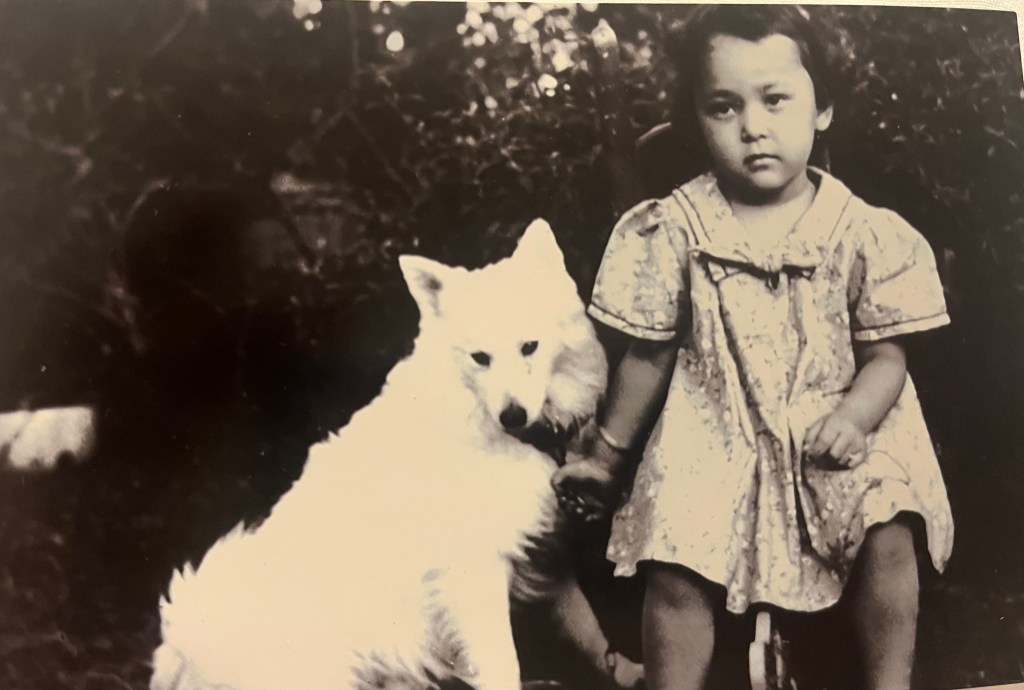
December 7, 1941 is a day I read about in school countless times, but more notably, this is a Sunday that my grandma will never forget. At just four years old, my young grandma was getting ready for church with her family when the island of O’ahu shook from the impact of Japanese bombs on Pearl Harbor. My grandma has graciously shared her memories of that day and the years that followed suit.
12-7-41 by Grandma
At the time, we lived in Palama, which was fairly close to Pearl Harbor. I remember big black puffs of smoke in the air that morning. My dad’s coworker came running to the house, “Kimo! Kimo! This is for real, we need to report to the station, we’re being attacked!” I didn’t know what it meant at the time, but I remember watching my dad put his police uniform on and being gone for what felt like forever. I remember missing my dad. For me, it was also so nice to have my family close. My older cousins were attending boarding school at Kamehameha. I remember being told that they were sent home because part of the school was used as a medical facility and morgue. We taped up the windows and car headlights and all the cousins slept on mattresses together in the middle of the house. We had local block wardens roam the streets at night to check for lights. My mother even served as a block warden. My aunt, who was a secretary to an Admiral, lived in housing on post at Pearl Harbor. She visited the family and shared that while she was watering her yard on that infamous morning, she saw the face of one of the Japanese pilots as they swooped in low to attack. My two cousins were in Kane’ohe Bay when the Marine Corps Station was attacked. One teenage cousin was a boy scout, and they were just about to sail into the bay when the attack happened. My aunty and uncle had no idea what had happened to him in those initial days. Since there were no cell phones at the time, communication between family was difficult.
We lived in a neighborhood with many Japanese families, and after the attack, they all stopped wearing their kimonos. We all had to wear gas masks and learn how to keep them strapped over our shoulders. We all moved to Waikiki, across from a large bomb shelter and there were air raid sirens that would signal a drill. I remember sitting on my older cousin’s shoulders as he carried me into the bomb shelter for one of the drills. At the time, Waikiki Beach had wires all across it to keep the enemy out. Victory Gardens became a staple war effort for locals to ensure sustenance. Many schools would plant their own Victory Gardens, too. I was a crazy little kid and I probably remember different things from the other kids at the time, but I remember when we finally had real butter again. During the war, we had NUCOA that looked and even tasted like CRISCO. It came with a little red capsule. My mother would mix the capsule into the white stuff to make it look like butter. I was so happy when the real butter came from New Zealand! Another distinct change I remember was a new fear of leaving the house. The war had really altered the way we all began to think and behave.
I asked my grandma if our family was ever concerned with receiving backlash for their Korean descent and Oriental features that can sometimes appear similar to those of Japanese people. She said, “No. At the time, the Korean community was well established, and we knew who everyone was. I had two uncles who were full Korean, and they were serving in the U.S. Army at the time.” Just 30 years earlier, Japan had occupied Korea in 1910. My great-great grandmother’s passport to Hawai’i in 1912 was not in Korean, but in Japanese. The Japanese government at the time was telling the world one story, but young Korean girls became ‘comfort women’ for Japanese servicemen, and many Koreans became enslaved by the Japanese at the time. Cultural contention lingered even in the Hawaiian islands.
As I listened to my grandma recount these stories with vivid storytelling skills, I soaked in the sound of her voice. A voice I could never take for granted. I was so quiet that my grandma even apologized for rambling on, but I had to assure her I was listening and pleaded for her to keep going. Learning my family history connected me to people I will never meet, and chills run down my arms as I realize that without them, I would never be here. I feel truly lucky to have someone willing to document our genealogy, and dutifully connect generations through storytelling and artifacts.
I would be remiss if I didn’t take a moment to acknowledge the men and women that lost their lives in the wake of this tragic battle. We give our deepest respects to the Soldiers, Civilians and Families who are forever impacted by this day and the days that followed.
Thank you to Pearl Harbor Tours for continuing to honor the legacies left behind on December 7, 1941.
To my readers,
Thank you for joining in on my mo’olelo kupuna. My cousin, Randall, recently taught me a new Hawaiian word: Mo’oku’auhau, which means ‘genealogy’. Reciting genealogy is deeply rooted in ancient Hawaiian culture. Our grandma has embodied this tradition for as long as I can remember and she has passed her deep appreciation for heritage to my mom, aunties, uncles, cousins and I. I do recognize that genealogy and history is important to many cultures beyond the islands of Hawai’i. And as we acknowledge our ancestors for their accomplishments and feats, we also make room for acceptance and deep healing in reverence to those darker moments in past time.
I would like to end this short and rich two-part series with a BIG MAHALO to my grandma who spent hours time traveling with me. Grandma, thank you for allowing me to see the world through your eyes and for your generosity in sharing your memories with love and grace. You are and have been an extraordinary woman, daughter, wife, mother, grandmother, great-grandmother, sister, and friend to so many. Mahalo nui loa e aloha wau ia oe.
References
https://www.kapapaolelohawaii.com/mo699ok363699auhau.html
https://www.hawaiinewsnow.com/story/38006499/hawaiian-word-of-the-day-moolelo/
https://www.primitiveways.com/kupuna.html

 THE HONEY WHINES